When to Use an AI Agent Factory in 2026

An AI agent factory splits AI work into separate stages, and each stage hands its output to the next. It’s useful for the steps where the AI has to follow a rigid rule or give you output in a very specific format, such as meeting a compliance requirement or applying your brand standards. For those steps, an enforced stage makes sense.
For the rest of the work, I don’t think a factory is the right tool. What you really want is clearly defined goals, plus guidance, context and data organized so the AI can easily use it. With those, today’s AI can plan the rest of the work itself.
At TJ Digital, our article production process has enforced stages to make sure we aren’t linking to competitors and that all of the facts we cite are accurate.
Table of Contents
What Is an AI Agent Factory?
What makes something an AI agent factory is that the work is split into separate, siloed stages or roles, all set up before any work starts. The factory takes a specific type of input, which might just be a prompt, and it’s built to reliably produce a high-quality output. You could build one that makes videos, websites or entire pieces of software.
Say you’re building a factory that produces videos. The first stage might be research, run by a researcher agent with its own folder of skills (saved instructions the AI loads for a certain kind of task) and guidance on researching a video. The research is then passed along to the second stage, script writing, which has its own scriptwriting agent and its own folder of skills and guidance on writing good video scripts.
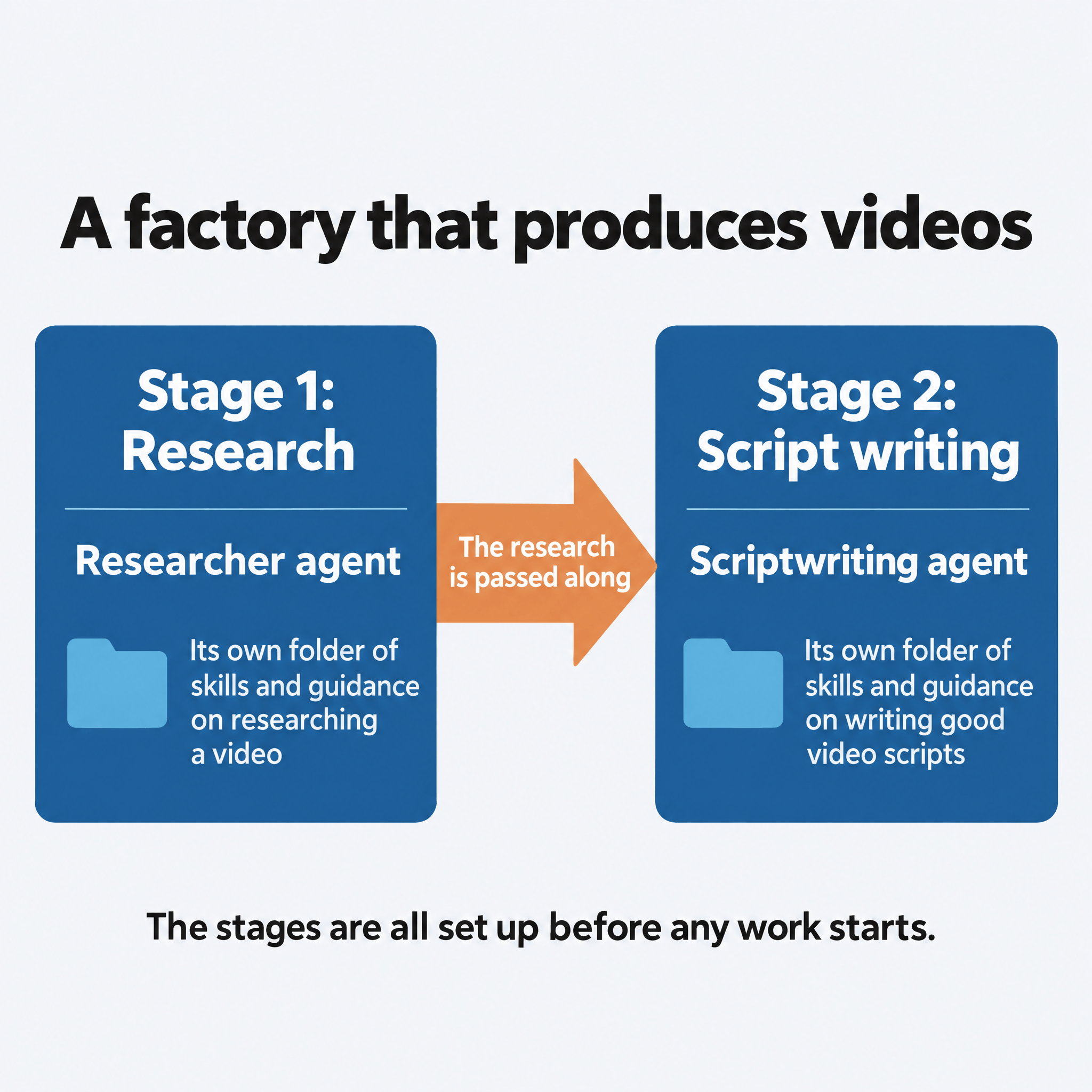
In the more rigid factories, the stages always run in the same order. The less rigid ones have a director or orchestrator agent at the top that makes the decisions about when to spin up the researcher agent or the scriptwriting agent.
NVIDIA’s “AI factories” are a different thing: there, the term means the computing infrastructure that trains and runs AI models at high volume.
Why Do People Build Agent Factories?
Factories work because they solve two real problems with AI workflows.
The first is that AI output tends to be inconsistent. A stage with one job and a defined output makes that part of the work reliable.
The second is getting the AI the right context. You want to give it all of the context, guidance and data that would help it achieve its goal, but you don’t want to just dump all of that into its context window. You want each agent to have just the context it needs to do its job, and in a factory, that’s what the folder for each stage is for.
This can be very effective for creating high-quality, reliable output.
When Is an Agent Factory the Right Tool?
An agent factory is the right tool for the steps where the AI has to produce the same kind of result every time. You don’t need a whole factory for that. One enforced stage, a step that always runs and always runs the same way, can sit inside work that’s otherwise flexible.
To find those steps, go through one of your workflows a step at a time and look for any step that involves:
- A compliance requirement the output has to meet
- A very specific output format, because a person or another tool depends on it
- Brand standards that have to be applied every time
- A handoff that has to happen the same way every time, such as a draft going to a set person for approval before it’s published
What Anthropic calls prompt chaining is the simplest kind of factory. The work runs through a fixed series of prompts, and each prompt works on the output of the one before it. Anthropic’s guide to building effective agents calls this “ideal for situations where the task can be easily and cleanly decomposed into fixed subtasks.”
So if you can write down every step in advance, and the steps don’t change from one job to the next, a fixed sequence can fit the whole job.
When Should You Not Build an Agent Factory?
For most work, I don’t think an agent factory is the ideal structure. Most projects don’t need the same steps every time, and a factory can only run the stages it was built with.
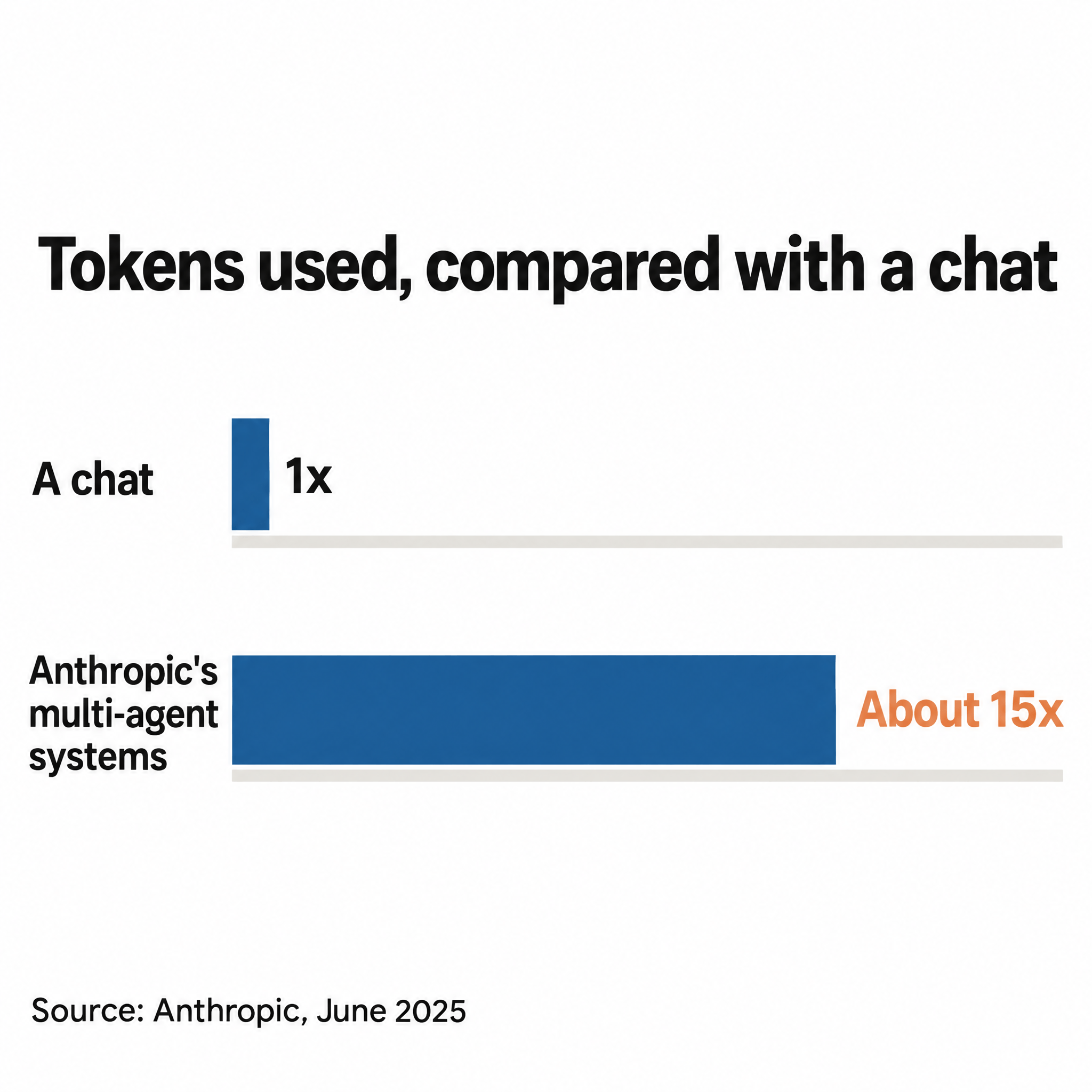
An agent factory is also a multi-agent system, and those cost more to run. Anthropic found that its multi-agent systems use about 15 times as many tokens as a chat. In a rigid factory, every stage runs on every job, whether the job needs it or not.
Anthropic and OpenAI both tell people to start simple. Anthropic recommends “finding the simplest solution possible, and only increasing complexity when needed.” OpenAI’s practical guide to building agents says, “Our general recommendation is to maximize a single agent’s capabilities first.”
A factory also limits what each stage can see. Each stage only sees what the stage before it handed over. In the video example, the research stage decides what the script stage gets, and the script stage never sees the rest.
Claude Code can run a multi-step workflow as a chain of sub-agents: separate agents that the main AI starts, one after another, to handle each piece of the work. Claude Code’s documentation says each sub-agent “starts with a fresh, isolated context window. It doesn’t see your conversation history, the skills you’ve already invoked, or the files Claude has already read.”
That’s fine for a piece of work that stands alone. It’s a problem when the steps depend on each other. The same documentation says to keep the work with the main AI, instead of handing it to a sub-agent, when “Multiple phases share significant context, such as planning, implementation, and testing.”
You still want each agent to get just the context it needs. In a factory, you decide what that is before any work starts. Today’s AI can decide it for each job.
Can AI Decide What Context to Give a Sub-Agent?
Today’s AI doesn’t need you to tell it exactly what context to hand over to a sub-agent. As long as it understands what the goal is and it has a clear map of all the context and data it can pull into its context window, it’s really good at putting together a plan, spinning up sub-agents and giving them just the context they need.
Anthropic’s guide to context engineering for AI agents describes agents working this way. Instead of being handed everything up front, they keep track of where things are, such as file paths and web links, and load what a task needs “into context at runtime.”
Anthropic’s building-agents guide describes the same kind of setup: a lead model breaks each task into pieces as it goes and hands them to other models. It calls that setup “well-suited for complex tasks where you can’t predict the subtasks needed.”
This can look a lot like a factory with an orchestrator, since in both cases one agent hands work to others. The sub-agents still start with a fresh context, too. The difference is that the main AI keeps the goal and the full picture the whole time. It decides what to hand off for this job, gives each sub-agent only what that piece needs, and gets the results back.
| Agent factory | Goals and context | |
| Who decides the steps | You, before any work starts | The AI, for each job |
| What each agent works from | Its stage’s folder, plus what the stage before it handed over | What the main AI decides that piece needs |
| What runs on every job | Every stage, in a rigid factory | What the AI plans for that job |
| Where it fits | Steps that have to follow a rule or format | Most other work |
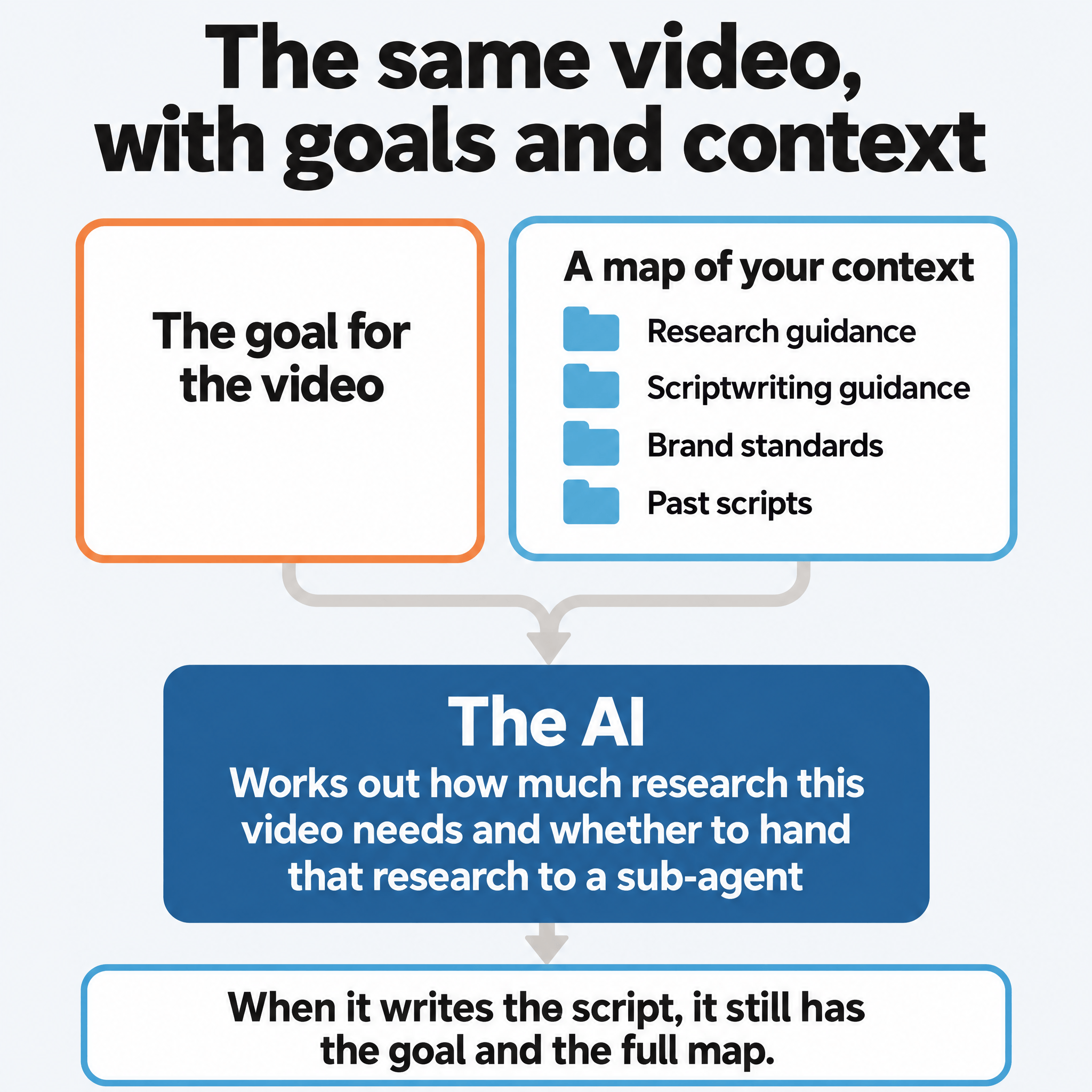
In the video example, you’d give the AI the goal for the video and a map of your research guidance, scriptwriting guidance, brand standards and past scripts. It works out how much research this video needs and whether to hand that research to a sub-agent. When it writes the script, it still has the goal and the full map.
What to Set Up Instead of an Agent Factory
For most work, set up these three things instead of a factory:
- Clearly defined goals. Tell the AI what the finished work needs to achieve and what done looks like, then leave most of the decisions about how to get there to the model. It’s the same approach I recommend for writing Claude skills, where a rigid rule goes in only when you have a reason for it.
- A clear map of your context. Keep your guidance and data in clearly named folders the AI can reach, and add a short file that lists each folder and what’s in it, so the AI knows where to find things. If you’ve already built factory folders, the guidance in them is still useful, and the map just points to it. That’s what context engineering is about.
- Enforced stages for the steps that need a rule. Keep a fixed stage for each compliance check, required format, brand standard or approval step, and let the AI handle everything around them.
Outside the enforced steps, the goals and the guidance are what keep the work consistent. The AI works toward the same definition of done, from the same guidance, on every job.
If your team shares that context, it also needs an owner. I cover that in managing a shared AI knowledge base for your team.
Will Agent Factories Still Make Sense as Models Improve?
Factory patterns can be very useful, at least right now. I don’t think they’re the future of how we use AI.
To me, factories are another example of us trying to get AI to work the way humans do. They’re useful for helping us understand what the AI is doing, since each stage has a clear job and an output you can look at. But AI agents are not factory workers, and as AI gets smarter and more capable, I believe frameworks like these will hinder it more than they help.
Spelling out every step used to help weaker models, and with current models, those fixed steps usually hold them back.
If you’re choosing what to spend time building now, I’d put it into the goals and the context. A factory’s stages fix one way of splitting up the work. As models get better at planning the work themselves, those stages are what you’d end up rebuilding or removing. The goals and context you organize keep their value, because a more capable model can do more with them.
If you have questions about any of this, reach out through our contact page or email me at [email protected].