What Does Google Connected Apps Mean for My Business in 2026?

Google’s connected apps are outside apps, like Instacart and Canva, that work right inside AI Mode in Google Search and in the Gemini app. On October 28, 2026, Google opened a preview that lets more developers apply to build them. Google is clearly trying to set things up so that, eventually, any business could submit its own app to appear in Google Search.
For most businesses, this doesn’t change how customers find them yet. Most connected apps so far are only in the Gemini app, so people searching on Google don’t see them. The connected apps that recommend local businesses are marketplaces you can already be listed on, like Angi and Thumbtack.
Building your own app usually doesn’t make sense yet either. Google’s guidelines say a good connected app gets better when someone signs in or finishes a task for them, which for a single business usually means customers need an account with you. So your app would mostly reach people who are already your customers.
What you can do now is make sure you’re listed in the connected apps that recommend businesses like yours.
It’s also worth starting on an MCP server, which lets AI tools like Gemini and ChatGPT work with your own booking or ordering system, for example to check your availability or book an appointment. Google’s connected apps are built on MCP servers. But one MCP server can work with many AI tools, so it’s useful even if you never build a connected app.
I run TJ Digital, an SEO and AI search agency. We track how often ChatGPT, Google AI Mode and AI Overviews mention our clients on the searches their customers make, so I pay close attention whenever Google changes how it decides who to send people to.
Table of Contents
What Is Google Connected Apps?
Google Connected Apps lets an outside app handle part of a task for you inside AI Mode or the Gemini app, so you don’t have to leave Google to get it done. In Google’s own example, you ask AI Mode for a barbecue grocery list. If you’ve connected Instacart, it can add the ingredients straight to your Instacart cart, and you check out in Instacart’s app or on its website.
Once someone has connected an app, they can name it when they ask AI Mode or Gemini for help. Google may also default to the last app they used for that kind of task.
What Did Google Announce on October 28, 2026?
On October 28, 2026, Google launched a preview of its Connected Apps Platform, which lets more developers build connected apps on their own. Until then, according to 9to5Google, building one meant working closely with Google. Now a developer builds an app once, picks whether it goes live in Search, the Gemini app or both, and sends it to Google for review.
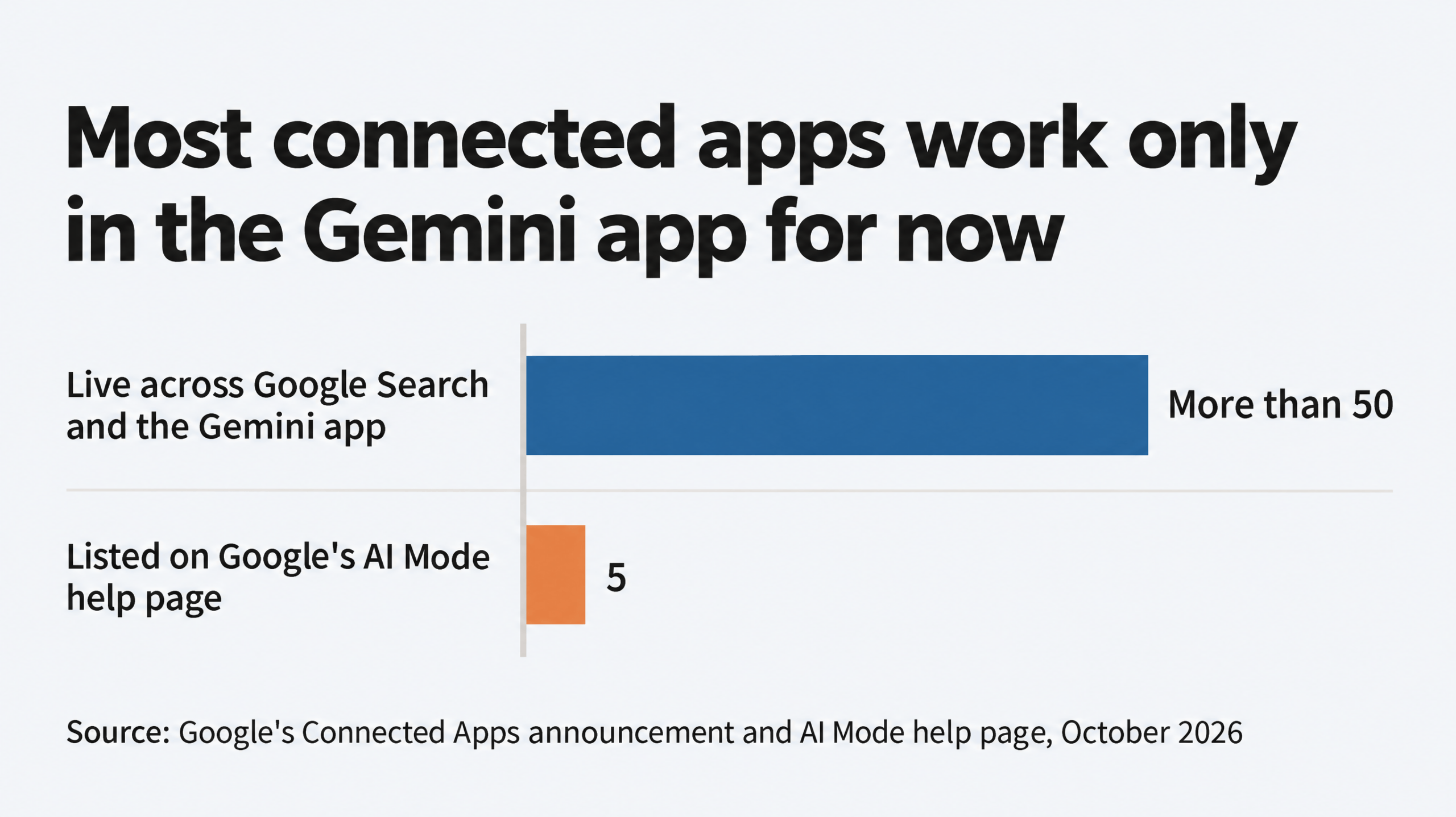
The Connected Apps program is still small, especially in Google Search:
- Who can build one: Developers have to apply to join the preview, and TechCrunch reports it’s open to developers in the U.S. for now. Google says it will add more developers, markets and Google products in phases.
- Where customers can use them: Connected apps in AI Mode only work in the U.S. and in English. In Gemini, availability depends on location, language and device.
- How many there are: Google says more than 50 are live across Search and Gemini. Only five are listed on Google’s AI Mode help page: Instacart, Canva, YouTube Music, Yahoo Fantasy Football and Sleeper Fantasy Football. So most of them work only in the Gemini app for now.
Should My Business Build a Connected App Right Now?
Most businesses shouldn’t build a connected app yet. Before you go off and vibe code an app that just recommends your business, know that it does seem like Google is being pretty picky about which apps it approves, at least for right now. Google reviews and tests every app before it’s available to everyone. Its policy for connected apps also lists the reasons it can reject one.
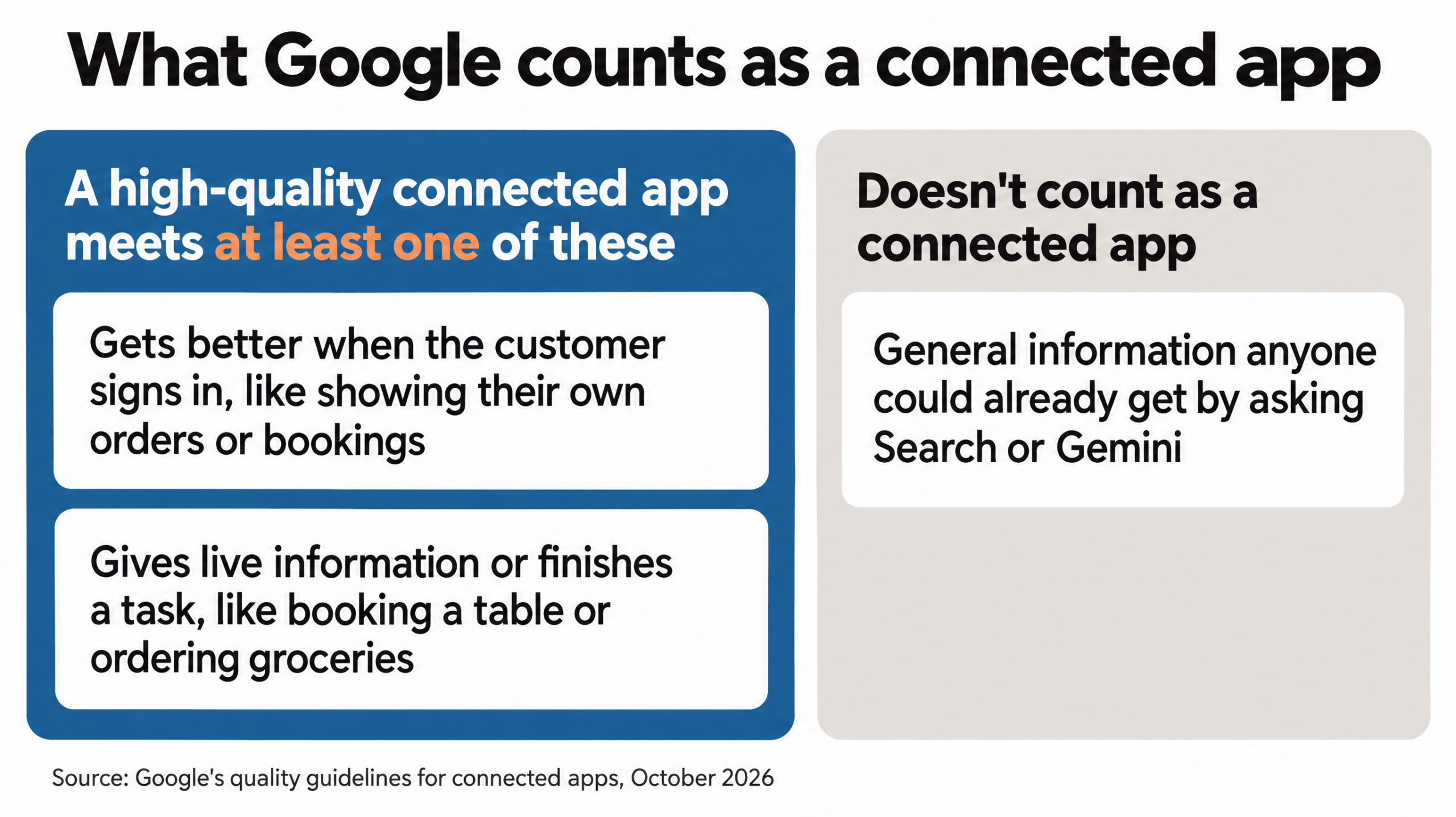
Google’s quality guidelines say a high-quality connected app meets at least one of two standards. One standard is that the app gets better when the customer signs in, for example by showing them their own orders or bookings. The other is that it gives live information or finishes a task for them, like booking a table or ordering groceries.
The same guidelines say an app that only offers general information, the kind anyone could already get by asking Search or Gemini, doesn’t count as a connected app. An app that just recommends your business doesn’t need an account and tells people nothing a search couldn’t, so I don’t think it’s what Google is looking for.
That makes connected apps a fit for businesses that already run software their customers use, like a booking platform, a marketplace or a subscription service. Google’s suggested uses include home-services marketplaces, restaurant reservations and e-commerce platforms.
Building one is also a real development project that takes a developer. Google’s developer documentation covers the steps, from setting up the server the app runs on to submitting it for review.
Is Connected Apps Google’s App Store Moment?
I don’t know if Connected Apps will be Google’s iPhone App Store moment. OpenAI tried something similar when it launched apps in ChatGPT in October 2025, and in my view, that didn’t really go anywhere.
John Mueller, a Search Advocate at Google who doesn’t work on connected apps himself, thinks it’s early too. He shared his personal view on LinkedIn: he’s excited about connected apps as a search platform, and it’s “still extremely early,” as Search Engine Roundtable reported.
Why Is Google Building Connected Apps?
I think Google is building Connected Apps because it wants to depend less on websites and have more control over where the information in Search comes from. Google’s job is to get you whatever information you ask for, and in the future, to let you take any action you might want to take online. The source of that information is the open web.
Google has done a better job than anyone at figuring out what information can be trusted, but it’s far from perfect. The truth is, anyone can publish a website. And now with AI, anyone can create a very high-quality website and publish content at scale.
The piece Google is missing to make Search truly trustworthy is some kind of verification, and it has been setting up verification gates like that for years:
| Verification gate | Who it’s for | What you verify |
| Google Business Profile | Local businesses that meet customers in person | That you own the business and its listing |
| Google Merchant Center | Online stores | That you own your store’s website, which you do when you set up Merchant Center to list your products on Google |
| Agentic Resource Discovery (ARD), a June 2026 standard for publishing what AI assistants can do with a business | Businesses that let AI assistants do things for their customers, like book an appointment | That you own the website you publish that information on |
| Connected Apps, October 2026 | App makers that want their app inside Search and Gemini | That you own the domain your app runs on |
Connected Apps gives Google one more way to check who’s behind what it offers people in Search. Before an app built on Google’s new platform goes live for everyone, its owner has to prove they own the app’s domain, and Google reviews and tests the app.
Business Profile and Merchant Center are less strict, because you can show up on Google without verifying through them. A business can appear on Google Maps without a verified Business Profile, and an online store’s products can appear on Google without Merchant Center. Verifying is how you take control of what Google shows, like editing your own business hours or managing your product listings.
That makes verification close to mandatory for any business that depends on Google. If you meet customers in person, I’d verify your Business Profile, and if you sell online, I’d verify your store in Merchant Center.
Will Google Let Businesses Pay to Have Their Apps Shown More Often?
Google’s policy for connected apps bans apps from showing other companies’ ads. But Google’s announcement, developer docs and policy say nothing about businesses paying Google to have their app shown more often. I think paid placement could happen, though, because this pseudo-mandatory verification also potentially solves one of Google’s major revenue issues right now.
Google earns less from a search in AI Mode than from a traditional search, and AI Mode searches are growing fast. Google’s Chief Business Officer, Philipp Schindler, pointed to both on Alphabet’s October 2026 earnings call.
Apps that Google has reviewed are apps it can show people with confidence. When someone makes a general request in AI Mode, they can pick an app from a list Google shows them. I think there’s nothing stopping Google from letting businesses pay to have their apps served more frequently in that list, which would help make up for AI Mode earning less.
What Should My Business Do About Connected Apps Now?
I think Google is going to lean less on websites and more on apps and businesses it has verified. My advice is don’t fight it. Google will likely continue to be your biggest potential source of revenue.
How Do I Get My Business Into Google’s Connected Apps?
For most businesses, the way in is to be listed in an app that’s already connected, like Angi or Thumbtack. Pay attention to the apps Google adds, and make sure you’re in any of them that can recommend your business.
These connected apps in Gemini already recommend local businesses. None of them is on Google’s list of AI Mode apps, so for now, people can only use them in the Gemini app:
| Type of business | Connected app to be listed in | Where it works |
| Home services, like plumbers, electricians and roofers | Angi and Thumbtack | U.S. |
| Healthcare providers that take appointments | Zocdoc | U.S. |
| Restaurants | OpenTable | U.S. and U.K. |
If your industry isn’t here, Google’s table of Gemini connected apps lets you filter by category. If you run a home services business, a complete profile on Angi and Thumbtack can help outside Gemini too. They can be among the directories AI tools trust when they recommend local businesses.
What Should Online Stores Do?
Online stores should start with Google Merchant Center, which can put your products in Google’s free product listings across Search, Gemini and more. Merchant Center also has a program, separate from free listings, that lets shoppers buy from your store without leaving AI Mode or Gemini. I explain how it works in how stores can sell directly in AI Mode and Gemini.
What Is an MCP Server, and Does My Business Need One?
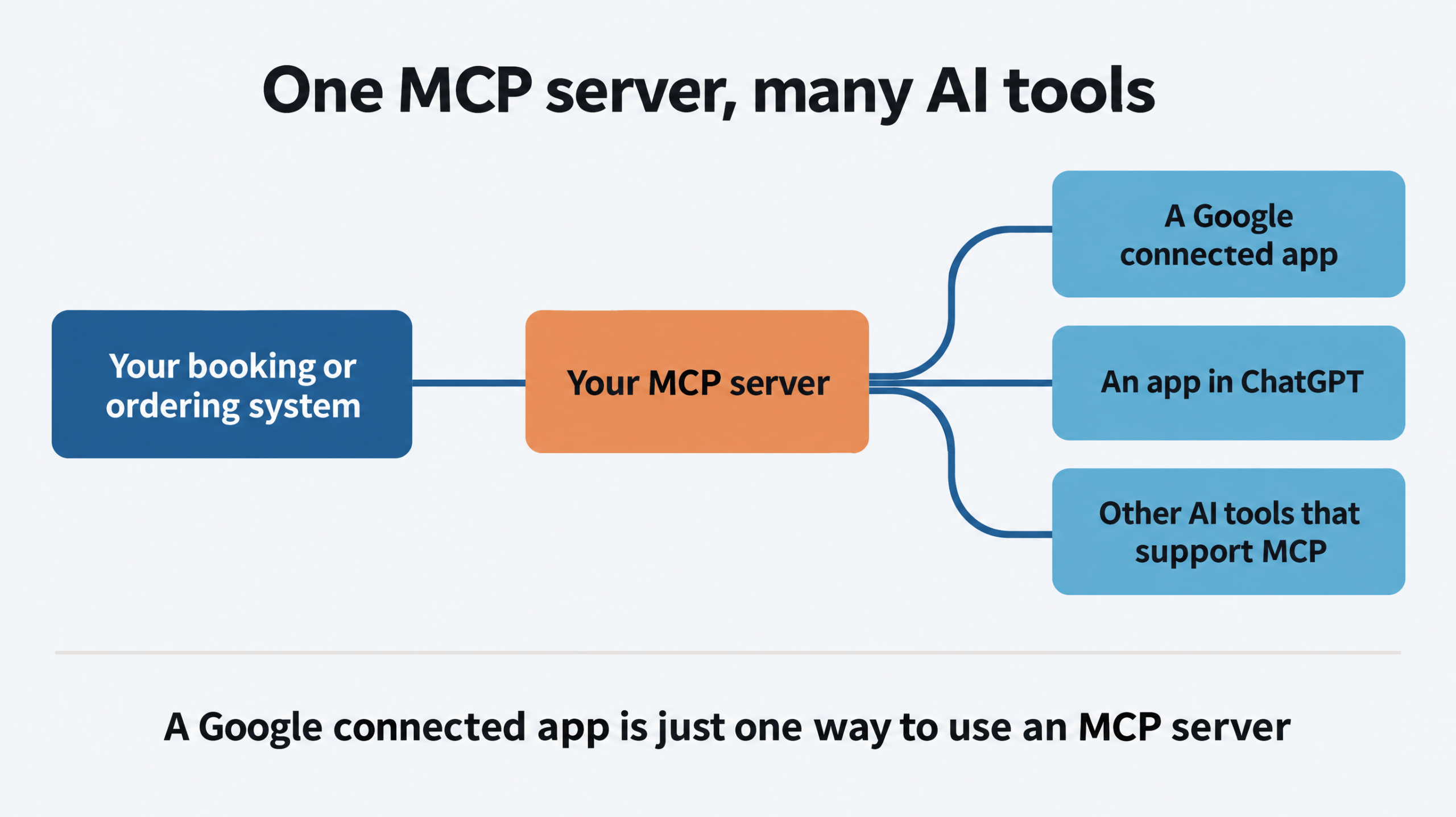
An MCP server lets AI tools work directly with your business’s systems, like the software you use to take bookings or orders. With one, an AI tool could check your availability or book an appointment when a customer asks it to. MCP (Model Context Protocol) is the open standard behind it, which Anthropic released in 2024.
Starting on an MCP server is a different project from building a Google connected app. A Google connected app is just one way to use an MCP server, and ChatGPT’s apps are built on MCP too. Because MCP is a shared standard, the same server can work with any AI tool that supports it.
At TJ Digital, the AI that does our hands-on work runs inside a system we built and call Tavi. Tavi holds our step-by-step procedures for work like articles and video edits, plus a knowledge base for each client, which we call a Brand Ambassador. Because we connect to Tavi through MCP, it works with Claude, ChatGPT, Gemini or any other AI that supports MCP.
AI agents are AI tools that carry out a task for someone, like finding a plumber who can fix a leaking sink today. I see MCP as the standard by which agents will interact with your business on behalf of a person. I’d also say it’s already the prerequisite for almost any integration with AI.
I think within a year or two, MCP is going to become mandatory for every business, so it’s worth starting now. Setting up an MCP server is developer work, so ask your developer about it. If you don’t have a developer, ask the company behind your booking or ordering software whether it offers an MCP server.
If you want to talk through what any of this means for your business, reach out through our contact page or email me at tj@tjrobertson.com.